
The what survived. The why evaporated.
Cognitive Mesh Architecture didn't start as a theory. It started as a frustration with my own work.
I was building constantly — ventures, systems, the architecture itself — and making decisions all day. Which approach, which tradeoff, why this and not that.
The decisions got recorded, more or less. The reasoning behind them didn't.
A week later I'd be staring at a choice I'd clearly made on purpose, with no durable record of the purpose.
The what survived. The why evaporated.
Then I watched it happen to someone whose "why" was worth a lot more than mine.
Park Howell — the EMMY-winning founder of Business of Story and creator of the Story Cycle System, the brand-storytelling framework the StoryCycle platform itself is built on — was reviewing a brand-story agent's output with me. He'd read what the agent produced, then revise and redirect it, and every redirect carried his reasoning: why this framing missed, why that one landed.
The output kept getting better. His reasoning kept disappearing.
Nobody was capturing the why behind the revisions, only the revised result. Session after session, the most valuable thing in the room — the judgment of the person who literally wrote the framework we were building on, applied live — evaporated the moment it was applied.
That's not a personal quirk. It's a pattern I've watched repeat across every venture I run. The judgment that tells you which draft is right, which decision fits the strategy, why the good version is good — it lives in people's heads and walks out the door when they do. And the AI most teams bought to help mostly made it worse: more output, faster, drawing on the same thin record of preserved reasoning.
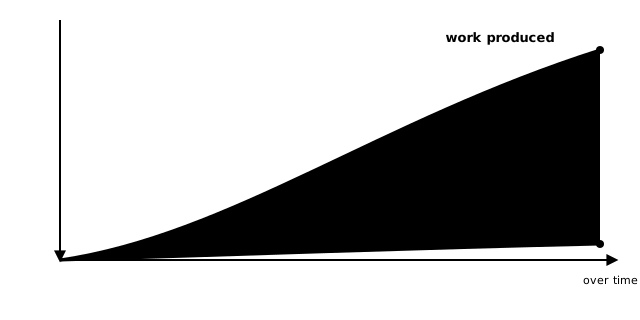
Speed was never the constraint. The reasoning was.
Here's the reframe the whole framework rests on.
Efficiency gives you a one-time step up. You do the thing faster, and then you've done it faster, and that's the end of the return.
It plateaus.
What I'm after is a return that grows — better decisions, sharper insight, capability that improves the more you use it. I call it Return on Intelligence: the gains you get when the reasoning behind your work is captured and fed back, so the next decision starts further ahead than the last.
That's the bet worth making — and the rest of this paper is about how you'd build a system to make it, and how you'd know if it worked.
How you'd actually preserve the why
Say you buy the premise. How do you actually build a system that captures reasoning and compounds it?
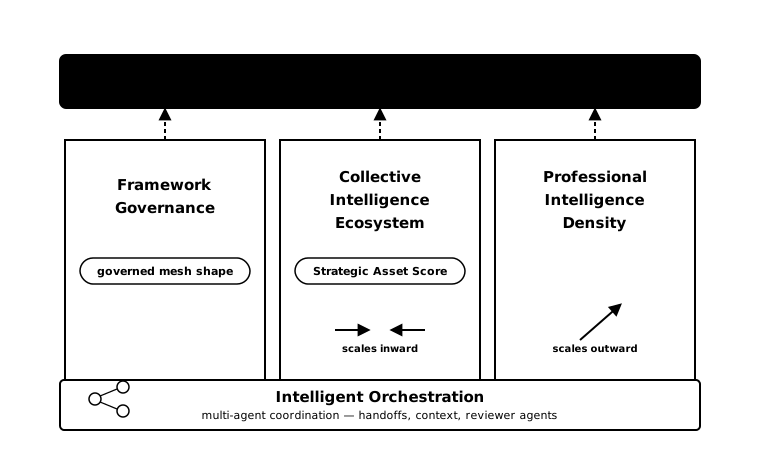
The architecture has three layers. A foundation: Intelligent Orchestration, then three pillars that make it distinctive: Framework Governance, Collective Intelligence Ecosystem, and Professional Intelligence Density. And one property that only emerges when all three run together: Return on Intelligence.
Start with what you're storing. Generative AI is very good at producing assets — fast, fluently, in volume. A decision write-up, an analysis, a spec, a draft — ask, and it appears.
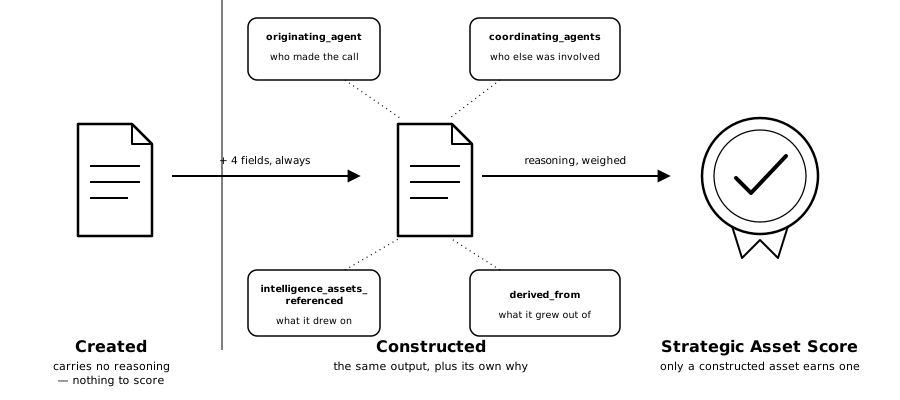
The asset lands; the reasoning that shaped it — what informed it, what tradeoffs it encodes, why this version and not another — never gets attached. So the base unit isn't the artifact, it's the artifact plus its reasoning: the difference between a created asset (just the thing the model handed back) and a constructed one (carrying its inputs, the judgment applied, and what it derives from). That's what I call Ultra-Intelligent Content.
The idea builds on Intelligent Content — the practice, pioneered by Ann Rockley and Scott Abel, of structuring content so it's discoverable, reusable, and reconfigurable instead of a one-off document. UIC keeps that discipline and adds one more layer: lineage and reasoning, so an asset doesn't just know what it is, it knows why it exists and what it grew out of.
Concretely, the part that's unconditional is small on purpose: four fields, always — originating_agent (who or what made the call), coordinating_agents (who else was involved), intelligence_assets_referenced (what else it drew on), and derived_from (the specific prior assets it grew out of). A few more fields kick in conditionally — an asset that makes a checkable claim also carries where that claim traces back to and how confident the source is — but the unconditional core stays at four.
That's deliberate, not thin: a shallow, universal core is what keeps every asset in the mesh queryable the same way, instead of every product inventing its own version of "provenance" and drifting incompatible with the others. A decision record isn't just "go with vendor B"; it's that conclusion plus derived_from: [prior pricing analysis, prior outage postmortem] and originating_agent: decision-agent — so six months later, the record doesn't just say what was decided, it can be traced back to exactly what informed it.
Beyond that shared core, each use case declares its own additional metadata on top — what a decision needs tracked isn't what a piece of content needs tracked, and the framework doesn't force them to be the same. The core stays universal so everything's still comparable at the mesh level; the extension is where the domain-specific judgment actually lives.
Nolan's decision records are where this shows up concretely. On top of the shared lineage, a decision carries fields no content asset would ever need: options_considered — each option weighed, with its pros, cons, and why it was rejected — chosen, rationale, and reversibility, so the record captures not just what was decided but how easy it would be to undo. None of that belongs in the universal core; none of it would mean anything on a piece of brand-story content. That's the extension doing its job — carrying the judgment specific to this domain, without forcing every other use case to carry it too.
A normal system saves what the AI generated; this one saves why it came out that way — because producing the artifact is cheap and fast next to the work of getting it right, it's the reasoning that compounds: captured and fed back, it's what makes the next decision start ahead of the last. That capture is meant to happen automatically, every time, everywhere in the framework — not something a user or agent has to remember to do.
The foundation: Intelligent Orchestration
Underneath everything sits ordinary multi-agent coordination — handoffs, context preservation, reviewer agents. It's necessary, and it's table stakes. In 2026, claiming coordination as your edge is like claiming a database as your edge. I name it as foundation precisely so the pillars don't have to carry weight that belongs to plumbing.
Pillar 1: Framework Governance
If every team invents its own way of structuring knowledge, the knowledge fragments and nothing accumulates. So CMA treats consistency as architecture: shared contracts for what an asset is, how it links, what "done" means — one coherent way of working across the mesh.
A quieter part of this is worth naming: governed mesh shape. The shape of the agent mesh itself — how many agents, how they coordinate, where a human's judgment sits — is a declared, versioned decision, not an accident of how someone wired it that afternoon.
A personal decision system and a content operation want different shapes; the framework governs the choice rather than leaving it to chance. That governance is meant to be enforced by the platform itself, not just by convention and good habits — the difference between a rule everyone follows and a rule the system won't let you break.
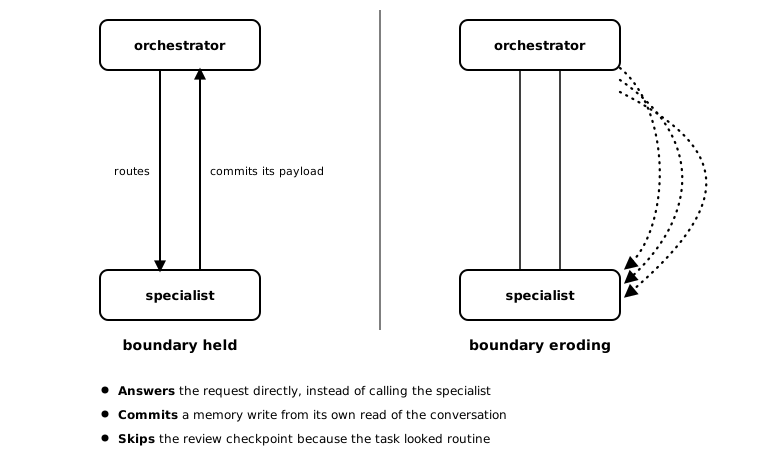
Here's why that governance earns its keep. Picture what happens when an orchestrator agent stops holding its own boundary — when, instead of routing to a specialist, it starts doing the specialist's job directly because that's faster than delegating:
- Answers the writing request itself, instead of calling the Writer specialist
- Commits a memory write from its own read of the conversation, instead of the payload the specialist actually returned
- Skips the review checkpoint because the task looked routine
Each shortcut looks harmless alone — even helpful, a quicker path to the same output. Six months in, nobody can give a clean answer to who actually decided what: the specialist trained for that judgment, or the orchestrator improvising past its own scope. That's what governed mesh shape prevents. In CMA, an orchestrator is explicitly not a specialist — it routes, holds context, and owns memory writes, but it doesn't produce content or make the calls a specialist is trained to make. That boundary isn't a convention a team remembers to follow; it's declared once in the mesh's topology, and every agent-to-agent call is constrained by it.
Pillar 2: Collective Intelligence Ecosystem
This is where captured reasoning lives, links, and gets weighted. Knowledge sits in a shared graph, each piece connected to what it derives from and what it supports.
Every piece also carries what I call a Strategic Asset Score — one number, built from a handful of plain questions: How strongly does this connect to what came before? How much real judgment does it carry, versus just information? Has it been checked and validated? Is it complete? Agents use that score to prefer well-formed, well-founded material over noise — the same way you'd rather start from a well-sourced answer than a guess.
"Strategic" is doing real work in that name, not standing in for "good." It's scoring the constructed version of an asset, not the created one — the reasoning attached to it, not just the artifact: what was weighed, what got rejected, what would change the call. A document doesn't carry that; a constructed asset does, and that's what earns the word. The score is a measured property of what the asset actually contains, not an adjective anyone could stick on anything.
A score is still not the same thing as trust, and CMA keeps them deliberately apart. Every piece also carries a standing — raw, curated, or strategic — and that one is earned, not calculated. It only changes when someone promotes the piece and says why, citing evidence that the scorer didn't produce: somewhere it was actually used, something it went on to inform, an outcome it produced. That standing is what settles disagreements — when two sources conflict, it decides which one wins.
The separation is not fastidiousness. A score moves in both directions, so if trust were computed from it, a piece would lose standing on a quiet Tuesday because a rescore came in a few points lower — no reason recorded, no one accountable, and the next agent quietly reaching for something else. I measured it before deciding: on live data, just over a fifth of repeatedly-scored assets would have been demoted that way. Quality you can compute. Trust has to be earned, and someone has to sign for it.
Any use case can extend those questions with its own — the same construct scores a decision, a contract clause, or a piece of content equally well. Meaning-based search (vectors) rides on top of that structure, so discovery combines "find similar" with "trace how this connects."
The outside evidence that this direction is sound is encouraging. In plain terms: search that understands how pieces of knowledge connect to each other answers broad, connect-the-dots questions more completely than search that just matches similar-sounding text — that's what Microsoft Research's GraphRAG work found, and vendor benchmarks from Diffbot and Lettria point the same way on questions that require piecing together multiple sources.
Pillar 3: Professional Intelligence Density
The pillar you actually feel — and the one easiest to mistake for solved. Persistent memory and long context windows are commodity now; any agent can retrieve what happened last session. That's not the claim here. The claim is narrower and harder to fake: what an agent draws on has to be validated professional judgment, not just prior conversation. An agent can have perfect recall of every session and still produce generic output, because remembering isn't the same as being dense with the domain methodology and judgment calls that made past work good. Scoring is what keeps density from collapsing into noise, and earned standing is what makes "validated" mean something — an agent operates on reasoning somebody vouched for, on the record, not on everything that's ever been said. That's the difference between "remembers your last conversation" and "expert from the first interaction, measurably better by the fiftieth."
Here's what makes that more than a claim: memory in CMA isn't one undifferentiated pile that never gets pruned, and it isn't wiped clean every session either. It's layered by how fast something needs to be reached and how much it's earned the right to stick around. A thin layer of pointers and thresholds loads first — small enough that an agent knows how to behave before it's pulled a single full asset. Underneath that sits the actual content, with its lineage attached. And retrieval by meaning, not just exact text, sits under that, so an agent can surface something relevant even when nobody thought to link it explicitly.
The layer that carries the density claim, though, is the first one — because that's where a single insight decides whether it gets to matter going forward. Nothing earns permanence just by being said once, however confidently it's said. A pattern the system has only seen once or twice stays provisional, and fades if it's never confirmed again. One that keeps showing up — the same judgment, reached independently, again and again — becomes something the system holds onto and weights accordingly. And the handful of insights confirmed so many times over that reversing them would take a real, deliberate decision becomes close to permanent: removable only by a person looking directly at a contradiction and saying so, on the record — not by a quiet cleanup job running on a timer.
Time by itself never promotes anything. Something said years ago that's never been reconfirmed carries less weight than something said last week that's already held up again. It's the same rule Pillar 2 puts on the Strategic Asset Score, one layer deeper: you can compute quality on the spot, but durability — whether an insight deserves to still be here next year — has to be earned by holding up under repetition, not by surviving the calendar.
What emerges: Return on Intelligence
Run the three pillars together on the orchestration foundation and you get the property none of them produces alone — intelligence that compounds. Which is also why a partial build can't deliver it: you don't get a fraction of compounding from one pillar. You get it from the whole, or you don't get it.
Notice that the three pillars scale in two directions at once. Professional Intelligence Density scales outward — one agent, more capable with every interaction, handling more of the work. Collective Intelligence Ecosystem scales inward — more contributors feeding the same shared graph, so the organization gets smarter as a whole, not just each person in it.
That's the difference between a tool that makes an individual faster and an architecture built for an organization: it has to get better in both directions at once, or it isn't really compounding.
Picture what that means at full strength. A team that doesn't relitigate the same tradeoff every couple of years, because the reasoning from last time is sitting right there, load-bearing, in the next agent's context. A new hire reasoning from the same accumulated judgment as the person who's been there a decade — not because they read a wiki, but because the system handed it to them at the moment they needed it.
That's the destination — and it's a simple thing to test for: the fiftieth interaction should be measurably better than the first, and the system should be able to show you why. Both halves of that test have now been run against real recorded work, not simulated data. One half is fully proven. The other is proven end-to-end on real work, and is now accruing the same proof under ordinary daily use. What was tested, how, and what's still open is tracked separately, so this claim doesn't need rewriting every time the evidence does.
How a deployment actually gets there
None of this shows up on day one. A new deployment doesn't start dense — it starts by borrowing. Early on, the system leans on frameworks and processes that already exist to pull out what the domain actually knows: existing playbooks, existing judgment, existing structure, extracted rather than invented from scratch.
What comes out of that extraction becomes the foundation — the core assets that define the domain: a brand story, a client profile, a decision the business made and why. Everything downstream builds on those. Next comes the layer that gives them teeth: operational specifics — playbooks, decision records, the actual engagement strategy — that turn a foundational asset into something usable in a live situation instead of a static reference. Then those two layers synthesize into something more ambitious: a customer journey, a campaign, a roadmap, an investment thesis — strategic frameworks built by combining what the foundation established with what context added.
By the time the system is producing real output, it's not generating content anymore — it's generating constructed content, complete with the lineage and reasoning the whole argument rests on. And once enough of that output exists and has held up, the system starts doing something a junior person learns to do too: reaching for its own best prior work as a working example, instead of starting cold every time.
That's the arc — extraction, foundation, context, strategy, construction, reuse — and it ends somewhere specific: the system stops looking like a general-purpose assistant and starts looking like someone who's done this exact job for years. It's the same test from a page back, restated as a road instead of a snapshot — not just "is the fiftieth interaction better than the first," but here's the actual shape of what happens between them. Not every deployment walks every stage in this order. The destination is what's required. The route isn't.
It's not only me who sees this
I didn't invent the idea that expertise is structured and transferable. Several research traditions point the same way — as support for the thesis, not proof of the architecture. None of this work studied multi-agent AI; it studied people, teams, and knowledge, and the lessons carry.
Gary Klein spent decades studying how firefighters, nurses, and military officers make fast, high-stakes decisions under pressure — including work with the Marine Corps on professional judgment — and lands on a useful finding: expert decision-making isn't mystical, it's pattern recognition built from structured experience, and structured experience can be captured. Anita Woolley and Thomas Malone's research on team performance found that a group's collective intelligence has its own factor, one that tracks with how the group is structured more than with members' raw individual intelligence — though that this structure can be deliberately engineered is my bet, not their finding.
Ikujiro Nonaka's work in organizational knowledge theory is about turning tacit know-how into something shareable; Walsh and Ungson's is about how that knowledge decays when people leave. And Sangeet Paul Choudary — writing in Harvard Business Review in 2026 — argues the logic extends to AI: its highest organizational value is coordination, lowering the costs that keep teams, tools, and data from working together, not a faster production line. That's an argument worth taking seriously, not a settled consensus, and CMA is essentially a bet that it's right.
The shape follows the work
The discipline that makes this work is layered, and it only runs one direction. The architecture defines what capabilities exist. A use case expresses how those capabilities behave in a real domain — concrete agents, concrete records, concrete outcomes. A platform implementation is code that demonstrates the use case is real.
Platforms don't get to invent capabilities the architecture never defined, and use cases don't get to skip proving a capability actually works before it's called part of the architecture. Two implementations show what that discipline produces — deliberately different shapes, descending from the same framework.
The Personal Intelligence Mesh (Nolan) started as my own lost-reasoning problem, made real. Nolan is an orchestrator that plays chief of staff: it loads context at the start of a session, routes each request to the right specialist by what you're trying to do — capture something, think a decision through, write, build a new agent — and holds the session coherent across those handoffs.
Underneath, decisions and lessons are stored as first-class records with their reasoning and provenance attached, and they carry time — so it can answer "what did I decide about this, and why, back when I decided it," not just "what's the latest note." That temporal, rationale-preserving decision memory is the direct answer to the ache I opened with.
StoryCycle Genie is our brand-storytelling system, built on the same framework in a completely different shape. Instead of one orchestrator with specialists on call, it runs a cascade: a foundation tier of strategic assets, a middle tier where specialists produce content grounded in that foundation, and a top tier of finished content — with an aggregation agent reading back up from the finished work to propose refinements to the foundation that produced it.
The loop closes in both directions: foundation shapes content, and content quality feeds back to improve the foundation.
That cascade has already produced real output — reviewed by the person whose framework it runs on. Park Howell scored StoryCycle Genie's machine-generated brand and audience stories against his own rules, with no human editing the output first. Real brands, including Happy Ladders, passed clean and repeatedly — not cherry-picked best runs.
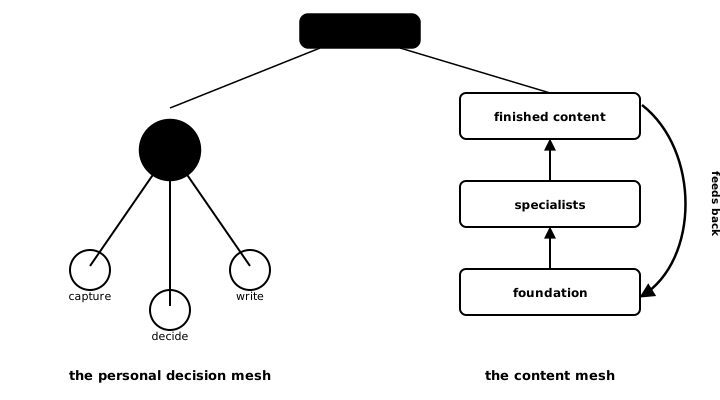
Same architecture, two structurally different meshes — because the shape follows the work, not the other way around.
The pieces exist. Nobody's put them together.
None of these five pieces is unprecedented on its own. Letta ships something close to the three-layer memory model. AWS's Bedrock AgentCore enforces a tool-permission boundary an orchestrator can't cross — closer to governed mesh shape than anything else I found. Salesforce's Einstein Trust Layer logs a mandatory audit record on every agent call.
What I couldn't find anywhere was one architecture that does more than one of these at once. The platform with enforced boundaries doesn't do memory. The one with tiered memory doesn't do provenance. The one with a mandatory audit trail doesn't separate a computed score from earned trust. Each piece is real and shipped. None of them live in the same system.
Gartner said as much directly, twice, in 2026. Enterprises are on a path from fewer than 15 agents today to more than 150,000 by 2028. Applying one uniform governance model across all of them, Gartner's own May release warned — in its actual headline — "will lead to enterprise AI agent failure." Their prediction: by 2027, 40% of enterprises will demote or decommission agents specifically because governance gaps only showed up once the agent was already in production.
It's the same claim I made about the three pillars, pointed outward instead of in: you get the property from the whole, or you don't get it at all. None of these five ideas needs to be original for the combination to matter. Treating them as one governed system, instead of five separate vendor relationships bolted on after the fact, is the piece nobody's shipped yet.
How far this goes
Domain reach. The differentiating machinery — governed mesh shape, a structured intelligence ecosystem, dense professional agents — doesn't care what domain the reasoning comes from. The architecture is built to operationalize professional judgment whether the domain is marketing, consulting, legal work, or care.
The care space deserves a specific note, because it's where the stakes are highest and where I have real ventures pointed — early-childhood intervention through Happy Ladders, and healthcare. The promise there is the same as everywhere: capture the reasoning, preserve it, compound it. But clinical and developmental contexts demand safety boundaries a content-operations architecture doesn't come with for free — consent, escalation, the limits of what an AI should ever decide. Those guardrails are a first-class part of the design, not something bolted on after the fact.
Focus protection. The system is meant to protect a user's focus rather than shatter it. Flow research is clear about the conditions people think well in — clear goals, immediate feedback, challenge matched to skill — and CMA treats those conditions as something the mesh has to actively defend, including noticing when a user's concentration breaks and helping restore it.
The operating loop that lets a deployment check itself runs as two distinct checks, deliberately kept separate. One audits whether the deployment was actually built to spec — its structural contracts still intact. A separate one monitors whether intelligence is actually compounding, not just running. Both feed a remediation step that's self-aware, self-diagnosing, and self-recommending, and deliberately not self-healing by default: human approval is the default for every fix, with narrow low-risk exceptions earned per deployment over time.
Network learning. At the network level, the same governance principle scales: when many deployments exist, cross-deployment learning is meant to flow through anonymized, opt-in telemetry, with privacy governed by consent tiers each deployment chooses for itself.
Portability. Intelligence captured this way belongs to the organization, not the vendor — it's meant to move with you across platforms, the same way the reasoning behind a decision should outlast the tool you used to make it.
The bet
The shift underneath all of this is from AI that optimizes for efficiency to AI that amplifies intelligence — and the difference between the two is whether the reasoning behind the work survives the work. That premise is the one Choudary argues: AI's real value is coordination, not production. CMA takes it as a starting bet and builds a coordination-first architecture on top of it — a structured knowledge store, a semantic retrieval layer, and agent meshes whose shape is a deliberate, governed choice.
If it works, the payoff isn't a faster quarter. It's an organization that gets measurably harder to out-think the longer it runs — one where turnover doesn't reset institutional judgment back to zero, and where year ten compounds on year one instead of just repeating it.
So the real question for a leader isn't whether to adopt AI collaboration. That's already happening. It's whether the version you adopt treats your organization's hardest-won judgment as something worth capturing and compounding — or as exhaust.
Sean Schroeder is the creator of Cognitive Mesh Architecture and co-founder of Reventure Labs and StoryCycle Labs, where CMA principles are being tested and refined.
Ultra-Intelligent Content builds on the intelligent-content work of Ann Rockley, Scott Abel (The Content Wrangler), and Renee Topper's Content OS framework — advancing from content-operations efficiency toward cognitive-intelligence amplification.